
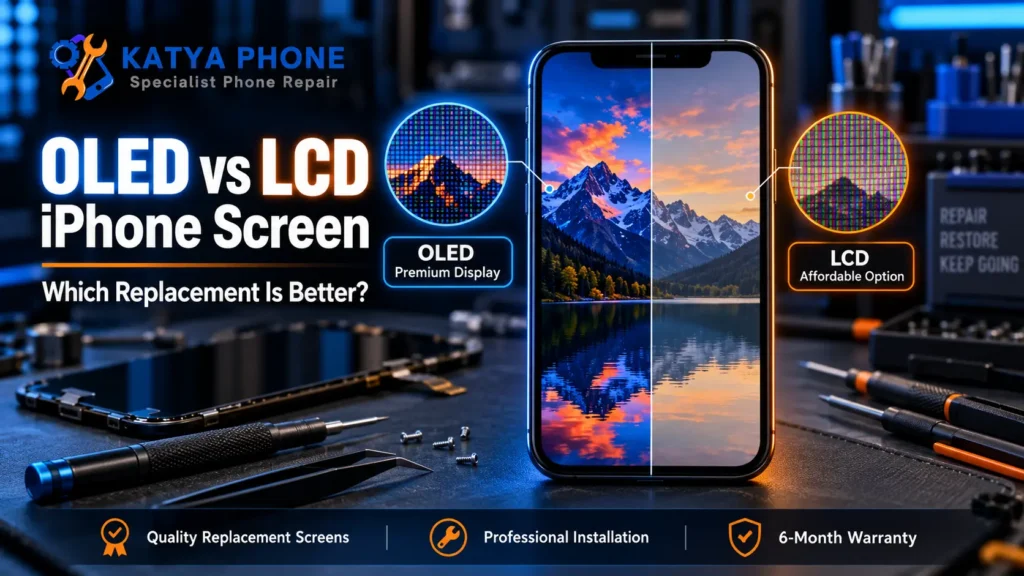
If you have cracked your screen and started ringing around for quotes, you have probably noticed the same phrase pop up: some shops quote an “OLED” replacement and others quote an “LCD” one, often with a big gap in price. So what actually changes when you pick one over the other, and does it matter for the way your phone looks and lasts? This guide breaks down OLED vs LCD iPhone screen options in plain language, from a repair bench in Melbourne’s west rather than a spec sheet. If you already know you want it sorted, you can jump straight to our iPhone repair service in Caroline Springs for a free quote.
OLED vs LCD: what the two screen types really do
An LCD screen (the older technology) works like a sandwich. There is a single backlight behind the panel that shines through coloured pixels. Because that light is always on behind the whole screen, “black” on an LCD is really dark grey, and the panel needs to sit a little thicker to fit the backing layer.
An OLED screen is different. Every pixel makes its own light and switches off completely when it needs to show black. That is why OLED displays can produce deeper blacks, stronger contrast and richer colours, and they can be thinner because they do not need a separate backlight. It also lets the screen use less power on dark content, which is part of why Apple moved its whole recent lineup to OLED.
Which iPhones use OLED and which use LCD?
This is the part that decides your quote before anything else, because you cannot freely swap between the two on every model. As a rough map:
LCD iPhones include the iPhone 6, 6s, 7, 8, XR, iPhone 11, and the iPhone SE (2020 and 2022). If you are holding one of these, an LCD replacement is the natural match and usually the more affordable path. Our iPhone 11 screen replacement guide covers that model in detail.
OLED iPhones start with the iPhone X, XS and XS Max, then the 11 Pro and Pro Max. From the iPhone 12 generation onward, every mainstream iPhone uses OLED, including the iPhone 17 range. On the Pro models, that OLED panel also drives the ProMotion 120Hz smooth-scrolling display. If you own one of these and want it handled quickly, the iPhone 17 repair page and our iPhone 17 Pro Max screen replacement guide show what same-day options look like.
“Can I put a cheaper LCD in my OLED iPhone?”
This is one of the most common questions we get at the counter, usually from someone trying to keep the bill down. These budget copies are called incell (or TDDI) LCD screens, and they now exist for almost the whole OLED lineup, from the iPhone X right up to the iPhone 17. So the honest answer is yes, a cheaper LCD-style option usually does exist for your model. The real question is what you give up.
An incell LCD in an OLED phone looks dimmer and shows greyish blacks instead of true black. On supported Pro models, choosing an LCD replacement can also mean losing features such as ProMotion 120Hz and the Always-On display, because an LCD panel simply cannot do them. That is why the price gap widens the newer your phone is, and why we do not recommend incell on Pro models for anyone who wants the phone to behave the way it did from the factory.
For a phone you plan to keep another year or two, most people are happier paying a bit more for an OLED replacement that matches the original. For an older phone you are about to trade or hand down, a budget incell screen can be a sensible way to stop the cracks spreading. There is no single right answer, which is exactly why we quote per situation rather than push one option.
Quality tiers: where quotes really differ
Not all replacements are the same, and this explains why two shops can both say “OLED” and quote hundreds apart. From closest-to-original down to budget:
- Original Apple Service Pack may be available for selected iPhone models, depending on supplier availability. It is the closest option to the original factory display.
- High-quality (soft) OLED is the strongest aftermarket option, flexible like the original and very close in everyday use.
- Hard OLED is a more affordable aftermarket panel that looks great head-on but can be slightly less even near the edges.
- Incell LCD is the budget copy covered above, with the trade-offs in brightness, blacks and Pro features.
Knowing which tier you are being quoted matters far more than the letters OLED or LCD on their own. At Katya Phone we explain which options are available for your exact model, including Original Apple Service Pack screens where we can source them, before starting any repair.
Durability, burn-in and the myths
People often ask whether OLED is fragile or whether it will “burn in”. In real drop terms, both crack when they hit tiles or concrete, so a case and a screen protector matter more than the panel type. Burn-in (a faint ghost of a static image) can happen on OLED after years of very heavy static use, but iOS shifts pixels slightly to reduce it and it is rare in normal daily use. LCD does not burn in, which is one genuine point in its favour for someone who leaves the same image on screen for hours every day.
The “display message” you might see after a repair
After some iPhone screen replacements, the phone can show a notification such as “Unable to verify this iPhone has a genuine Apple display”. This does not mean the screen is unsafe or badly fitted; it is Apple flagging that the part was not paired at the factory. Before you commit, it is worth asking whether True Tone, automatic brightness and other display features will be kept, because this varies by part and model. We tell you upfront what to expect for your phone.
What OLED vs LCD screen replacement costs in Caroline Springs
Because the panel type and quality tier drive the part cost, iPhone screen pricing lands in two broad bands, grouped by the screen your iPhone originally shipped with. These are current guide ranges at Katya Phone in Caroline Springs:
| Original screen type / model group | Guide price (AUD) |
|---|---|
| LCD-model iPhones (6/7/8/XR/11/SE) | $99 – $189 |
| OLED-model iPhones (X, XS, 11 Pro, 12 to 17) | $199 – $549 |
These are guide prices only. Prices may change depending on model availability and part quality. OLED-model iPhones (including the 12 to 17) can often take a lower-cost incell LCD screen that sits below the OLED range, but with the trade-offs above (dimmer, no 120Hz or Always-On on Pro models). The final quote depends on your exact model and the tier you choose. We confirm it after we identify the model, and every screen replacement carries our 180-day warranty on parts and labour.
Not sure which band your phone falls into? Bring it in for a free check and we will tell you the model, the options, and a firm price before any work starts. You can also read our full screen replacement service page for turnaround times and the suburbs we cover.
So, OLED or LCD: which is better?
OLED vs LCD iPhone screen choice comes down to your model and your plans. If your iPhone came with OLED, matching it with an OLED replacement keeps the brightness, deep blacks and (on Pro models) the smooth 120Hz motion you paid for. If your iPhone is an LCD model, an LCD replacement is the correct, cost-effective match. The trap to avoid is a cheap copy screen dressed up as a bargain without telling you which tier it is. Ask what panel and tier you are getting, and the decision becomes easy.
Related Articles
- iPhone 11 Screen Replacement: Cost, Repair Options & Common Mistakes to Avoid
- iPhone 14 Screen Replacement: Cost, Process & What to Expect
- iPhone 17 Pro Max Screen Replacement: Everything You Need to Know
- iPhone Screen Repair: When Should You Replace the Display?
- Mobile Screen Replacement Service in Caroline Springs
OLED vs LCD iPhone Screen – Frequently Asked Questions
Which iPhones have OLED screens and which have LCD?
iPhones from the iPhone 12 to the iPhone 17 all use OLED, along with the iPhone X, XS, XS Max, 11 Pro and 11 Pro Max. LCD models include the iPhone 6, 7, 8, XR, iPhone 11 and the iPhone SE (2020 and 2022). Your model decides which replacement screen fits.
Is an OLED screen replacement better than an LCD one?
For a phone that came with OLED, yes, because an OLED replacement keeps the deep blacks, brighter colour and (on Pro models) 120Hz smooth motion. For an LCD-model iPhone, an LCD replacement is the correct match and there is no benefit to forcing OLED. Better means matching the panel your phone was built for.
Can I put a cheaper LCD screen in an OLED iPhone?
Usually yes. These budget copies are called incell LCD screens and now exist for almost the whole OLED range, from the iPhone X up to the iPhone 17. The trade-off is a dimmer screen, greyish blacks instead of true black, and on newer or Pro models the loss of 120Hz smooth motion and the Always-On display. It can suit an older phone you are about to sell, but most people keep OLED on a phone they plan to hold onto.
Why does OLED screen replacement cost more than LCD?
OLED panels are more expensive to make and there are quality tiers within them (genuine, soft OLED and hard OLED), so the part itself costs more than an LCD. That is why LCD-model iPhones sit around $99 to $189 while OLED models range from about $199 to $549 at our Caroline Springs shop.
Do aftermarket OLED screens look as good as the original?
A good soft OLED replacement is very close to the original in everyday use for brightness, colour and blacks. Cheaper hard OLED panels look great straight on but can be slightly less even near the edges. We tell you which tier you are getting before you commit.
Will a replacement OLED screen get burn-in?
Burn-in on OLED is rare in normal daily use. It can appear after years of leaving the same static image on screen at high brightness, but iOS shifts pixels slightly to reduce the risk. If you leave a fixed image on screen for many hours every day, an LCD model avoids burn-in entirely.
Does replacing the screen affect Face ID or True Tone?
Face ID relies on the separate TrueDepth camera, so a correctly done screen replacement does not remove it. True Tone can be affected on some aftermarket screens; we handle the transfer where possible and tell you upfront if a particular part will not keep it.
How long does an iPhone screen replacement take?
Most iPhone screen replacements are done same-day and often while you wait, when we have your model’s part in stock. If we need to order a specific tier of panel, we let you know the timeframe before you leave your phone.
Is a budget replacement screen safe to use, and is it covered?
A properly fitted replacement screen, LCD or OLED, is safe to use day to day. Every screen we install carries a 180-day warranty on parts and labour covering manufacturing faults, so you are not left guessing on a cheaper option.
How do I know which screen my iPhone needs?
Bring it in for a free check in Caroline Springs and we will confirm your exact model, whether it is an OLED or LCD phone, the tier options, and a firm price before any work starts. Walk-ins are welcome.
The bottom line
Choosing between OLED and LCD is really about matching your iPhone and how long you plan to keep it. If your phone came with OLED, an OLED replacement keeps it looking the way it should; if it is an LCD model, LCD is the right and cheaper fit. Either way, the thing that protects you is knowing the exact panel and quality tier before you say yes.
At Katya Phone in Caroline Springs we quote per model, explain the options in plain language, and back every screen with a 180-day warranty. Pop in for a free check or call 0451 041 090 for a quote today. Caroline Springs and surrounding Melbourne-west suburbs, walk-ins welcome.
Pingback: Google Pixel Green Line on Screen: Repair or Replace?
Pingback: Can You Use an iPhone With a Cracked Screen? (2026)
Pingback: iPhone Ghost Touch After Screen Replacement: Causes & Fixes