
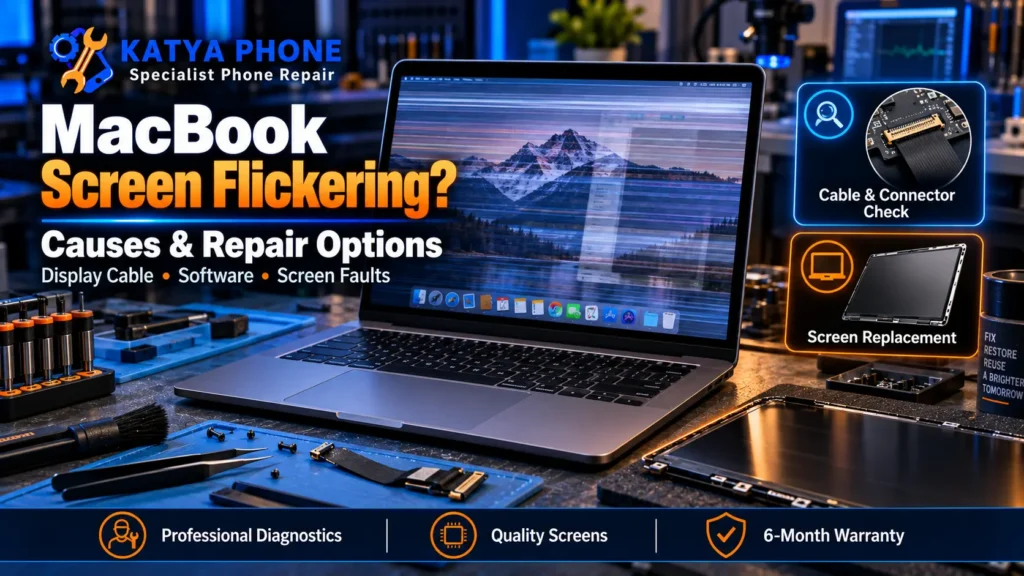
A flickering MacBook screen looks alarming, and most people assume the worst straight away: a dying display and a big repair bill. Here is the part that surprises them at our bench. In many cases, MacBook screen flickering is caused by software, a display setting, or heat rather than a failed display, and a lot of those cases cost nothing to fix.
We have been repairing Macs in Melbourne’s west since 2009, and we see this weekly. Sometimes it is a simple reset. Sometimes it is a worn display cable that has been quietly failing for months. The trick is knowing which one you are dealing with before you spend a cent. If you would rather skip the guesswork, our team can look at it during a free check at our MacBook repair shop in Caroline Springs.
This guide walks you through what actually causes the flicker, the quick fixes worth trying at home, how to tell software from hardware, and what a repair realistically costs if it comes to that.
What Actually Causes a MacBook Screen to Flicker?
Screen flickering falls into two buckets: software and hardware. Software is far more common, which is good news, because those fixes are usually free. Here are the causes we see most often.
- macOS bugs and corrupt settings. A recent update, a bad cache, or a corrupt display setting can make the screen flash, blink, or show quick black frames.
- Graphics handoff on dual-GPU MacBook Pros. Some MacBook Pro models switch between two graphics chips to save battery. The handoff is not always smooth, and flickering during that switch is a classic pattern.
- Browser hardware acceleration. If the flicker only shows up in Chrome or Firefox, the browser is likely offloading work to the GPU in a way macOS does not like.
- Heat. A hot MacBook, especially one left in a car over a Melbourne summer or run on a bed that blocks the vents, can flicker until it cools down.
- Worn display flex cable. On some older MacBook Pro models, especially certain 2016 to 2019 models, the thin cable that feeds the screen wears out near the hinge. This is the well-known “Flexgate” issue, and it often starts as a faint flicker or a bright band along the bottom of the screen.
- Failing backlight, GPU, or physical damage. A drop, a spill, a failing backlight, or a graphics chip on the way out will all cause flickering, usually with lines, distortion, or dark patches alongside it.
In 15 years of repairs, the cause people least expect is that tiny flex cable. The screen itself is perfectly fine. The cable feeding it has simply worn thin from thousands of open-and-close cycles.
Software or Hardware? How to Tell the Difference
Before anything else, work out which side of the fence you are on. If the flickering comes and goes, stops when you restart, only happens in one app, or started right after a macOS update, it is almost certainly software. Those are the cases you can often clear yourself in a few minutes.
It leans toward hardware if you see steady horizontal or vertical lines, colour distortion, a bright strip at the bottom of the screen, flicker that changes as you tilt the lid, or symptoms that started after a drop or spill. Hardware flicker also tends to get worse over time rather than better. When the lid angle changes the flicker, that points straight at the display cable.
Quick Fixes to Try First
Start with the safest, simplest steps and work down. Most people never get past step three. One thing to check before you begin: the exact steps for Safe Mode, NVRAM, and the SMC differ between Intel Macs and Apple silicon Macs, so it helps to know which chip yours has.
- Restart, then shut down and let it cool. A full restart clears a lot of temporary glitches. If the MacBook feels hot, shut it down for ten minutes so you can rule out heat.
- Update macOS. Go to System Settings, General, Software Update, and install anything pending. Display bugs are often patched in point releases.
- Test in Safe Mode. Restart into Safe Mode and watch the screen. If the flicker disappears, a third-party app or login item is the culprit, and you can remove recent installs one at a time.
- Turn off True Tone and auto-brightness. In System Settings, Displays, switch off True Tone. These automatic adjustments occasionally cause a subtle flicker.
- Disable automatic graphics switching. On a dual-GPU MacBook Pro, go to System Settings, Battery, Options, and turn it off. This forces one graphics chip and often stops the flicker.
- Reset NVRAM and the SMC. On Intel Macs, resetting these clears low-level display and power settings that can trigger flickering. Apple silicon Macs do this automatically on restart, so a full shut down and restart is the equivalent step.
One thing not to do: don’t press on the screen, flex the lid, or keep forcing the MacBook awake if you already see lines or distortion. That can turn a minor cable issue into a cracked panel. If none of these steps work, get a free check before spending anything.
Not sure where you have landed? Send us a quick photo or video of the flicker and we will tell you whether it is worth trying more at home or bringing in. No appointment needed for a look.
What We See at the Bench
The pattern we see most on some older MacBook Pros, especially certain 2016 to 2019 models, is Flexgate. The display works fine for months, then a faint flicker appears, or a thin bright bar shows along the bottom edge. People often ignore it because it comes and goes. By the time they bring it in, the cable has worn through and the backlight has started dropping out at certain hinge angles.
The common mistake is waiting. Early on, a flex cable issue is contained. Left too long, it can take the backlight with it, and that turns a smaller job into a full display replacement.
Modern MacBook screens are also bonded units. The glass, panel, and backlight are fused together, so a fault in one layer usually means replacing the whole display assembly rather than a single part. It is not the shop upselling, it is how Apple built the screen.
When the flicker is coming from the graphics chip or logic board rather than the display, that is a different story. We do not carry out board-level repairs, so in those cases we do an honest check, tell you plainly what we have found, and point you to the right option rather than charging for work that will not hold.
Why DIY Repair Is Risky
It is tempting to order a cable or a panel online and have a go. On a MacBook, that is riskier than it looks.
- The display is a bonded assembly, so a small slip can wreck the whole screen, not just the part you meant to fix.
- The flex cables are extremely thin and tear easily. One wrong move and a repairable fault becomes a replacement.
- Incompatible or low-grade panels can cause colour problems, dead pixels, or fail True Tone.
- Backlight and static handling on these screens is unforgiving without the right tools.
- Newer Apple silicon and T2 models add extra pairing and calibration steps that catch most home repairs out.
The savings rarely outweigh the risk of turning a minor fix into a major one.
What Changes the Repair Cost
There is no single price for a flickering screen, because the fault decides the fix. Here is a realistic guide for Caroline Springs and Melbourne’s west.
| Cause of the flicker | Typical fix | Indicative cost |
|---|---|---|
| Software, settings, or macOS bug | Reset, update, or setting change | Often free with a check |
| Worn flex cable or backlight | Display assembly replacement | $299 – $799 |
| Cracked or damaged display | Display assembly replacement | $299 – $799 |
| Graphics chip or logic board | Free check and honest referral | Assessed, not board-repaired here |
Prices are approximate ranges for MacBook models in Caroline Springs / Melbourne’s west, Australia. MacBook Air models sit at the lower end, 13-inch and 14-inch Pro models in the middle, and 16-inch Pro models at the top. Final cost depends on the device’s condition. Always request a free check before authorising any work.
If your flicker turns out to be a screen fault, our MacBook screen replacement cost guide breaks the pricing down by model. If the display checks out but the battery is also playing up, the MacBook battery replacement guide covers that side.
How to Keep Flickering From Coming Back
- Keep macOS updated, since display bugs are usually fixed in later releases.
- Close the lid gently and avoid over-flexing the hinge, which is what wears the display cable.
- Never leave your MacBook in a hot car. Melbourne summer heat is hard on screens, adhesive, and cables.
- Don’t stack heavy items on a closed MacBook. Pressure on the lid can damage the panel and cable together.
- Use a padded sleeve in bags and prams, where knocks and pressure are most common.
- Keep the vents clear and don’t run it on a bed or couch that traps heat.
- Back up regularly, especially on Apple silicon models where a board fault can lock the data away for good.
The one most people miss: in our experience, repeated hinge flex and heat can contribute to screen problems over time, not only accidental drops. Treat the lid gently and keep it cool, and the screen tends to last.
Why Choose Katya Phone
We have been fixing phones, tablets, and MacBooks since 2009, so a flickering screen is familiar ground. We look first and quote before we touch anything, so you always know what you are paying for.
We are honest about what a repair is worth. If it is a free software fix, we will tell you. If the board is the problem and repairing it does not make sense, we will say that too. We use genuine Apple parts where available for the model, or high-quality aftermarket where they are not, and we explain the options before we start. We are not an Apple Authorised Service Provider, and we always tell you that up front.
Every repair is backed by a 6-month warranty on parts and labour. We are local, serving Caroline Springs, Burnside, Deer Park, Ravenhall, St Albans, Taylors Lakes, and the surrounding suburbs. Drop in or call, no appointment needed for a free check.
Related Articles
More MacBook and screen help from our team:
MacBook Screen Flickering – Frequently Asked Questions
Why is my MacBook screen flickering?
Most MacBook screen flickering is caused by software: a macOS bug, a corrupt display setting, browser hardware acceleration, or heat. Less often it is hardware, such as a worn display flex cable, a failing backlight, or a graphics chip fault. If the flicker comes and goes or stops after a restart, it is usually software. Steady lines or distortion point to hardware.
Is MacBook screen flickering a hardware or software problem?
Usually software, which is the good news. Flicker that is intermittent, stops in Safe Mode, is tied to one app, or started after an update is almost always software. Flicker with horizontal or vertical lines, colour distortion, a bright bar at the bottom, or changes when you tilt the lid points to a hardware fault like the display cable.
Can I fix MacBook screen flickering myself for free?
Often, yes. Restart and let the MacBook cool, update macOS, test in Safe Mode, turn off True Tone, disable automatic graphics switching on dual-GPU Pros, and reset NVRAM and the SMC on Intel models. The exact reset steps differ between Intel and Apple silicon Macs. Many software-related flickers clear with one of these steps at no cost. If none work, the fault is likely hardware and worth a free check.
Does a flickering screen mean I need a new MacBook screen?
Not always. If the flicker is software or settings related, no screen replacement is needed. If it is a worn flex cable, failing backlight, or physical damage, the display assembly usually does need replacing, because modern MacBook screens are bonded units. A free check tells you which case you are in before any work begins.
How much does it cost to fix a flickering MacBook screen?
It depends on the cause. Software and settings fixes are often free with a check. If the display assembly needs replacing, a MacBook screen replacement typically runs roughly $299 to $799 depending on the model, with Air models at the lower end and 16-inch Pro models at the top. If the fault is the graphics chip or logic board, we do a free check and refer you honestly rather than charging for work that will not hold.
What is Flexgate and the stage light effect?
Flexgate is a known issue on some older MacBook Pro models, especially certain 2016 to 2019 models, where the thin display flex cable wears out near the hinge from repeated opening and closing. It often starts as a faint flicker or a bright bar along the bottom of the screen, sometimes called the stage light effect. Left too long, it can take the backlight with it, so it is best checked early.
Is it safe to keep using my MacBook while the screen flickers?
For a software flicker, it is generally fine to keep using it. If you see lines, distortion, or flicker that changes with the lid angle, avoid pressing the screen or forcing the lid, as that can turn a minor cable issue into a cracked panel. When in doubt, get it checked before the fault spreads.
How long does a MacBook screen repair take?
When the display assembly is in stock, many MacBook screen repairs are done the same day or next day. Timing depends on the model and parts availability, especially for older Intel models where parts can take longer to source. We confirm turnaround at the free check before you commit.
Will resetting NVRAM or the SMC stop the flickering?
It can, if the flicker is caused by corrupt low-level display or power settings, which is common on Intel MacBooks. Resetting NVRAM clears display-related settings, and the SMC controls backlight and power functions. Apple silicon Macs handle this automatically on restart, so a full shut down and restart is the equivalent step.
Do you repair flickering MacBooks in Caroline Springs?
Yes. We handle MacBook screen and display faults, including MacBook screen replacement, at our Caroline Springs shop and serve the surrounding suburbs including Burnside, Deer Park, Ravenhall, St Albans, and Taylors Lakes. Walk in for a free check with no appointment, and ask about pickup or drop-off if you cannot get to us. Availability depends on your suburb and the day.
A flickering MacBook screen is unsettling, but it is rarely the disaster it looks like. Most cases trace back to software, settings, or heat, and those cost nothing to sort out. When it is hardware, it is usually the display cable or assembly, and a proper repair puts it right without you replacing the whole machine.
The smartest move is to try the safe fixes above, then get a free check before you spend anything. If your MacBook screen is flickering, drop into our Caroline Springs shop or call us and we will take a look first, tell you honestly what we find, and only quote if there is a real fault to fix.
Call Katya Phone on 0451 041 090 or get a free quote here. No appointment needed for a free check, and we service Caroline Springs and the surrounding suburbs.